Monday, June 26, 2017

Europe on $10 a day


Europe on $10 a day

At present it may seem an absolute impossibility, yet in 1978 travelling through Europe on $10 a day was quite manageable.  For intercity travel, I had a 2-month unlimited pass (Eurail) on all Continental trains within Western Europe (‘Western’ in the Cold War context.)  Hence, the $10 per day was towards accommodation, food, local transport, entrance to sights and other miscellaneous expenses.

In places with stronger currencies, such as, the Scandinavian countries, Switzerland and others, occasionally going over the budget was a necessity.  Here my nylon tent came in quite handy to save on accommodation.  Also through friends I had free-stay in the Netherlands and Vienna.   As an interesting side anecdote, between Stockholm and Helsinki the Eurail pass also allowed travel on a sealiner.  The ship departed from each city at 5 PM and reached the other at 8 AM the following morning.  It offered a lavish smorgasbord at an affordable price, shower, swimming pool and sauna facilities plus spaciously reclining seats for sleeping.  The boat became my nightly accommodation while alternatingly daily between these two cities. 

On the other hand, Spain was comfortably affordable.  It was still recovering from the economic ills of its Francoist legacy and I was able to survive on $6 per day.

Hence, at the end it did average to “Europe on $10 a Day” as the title of a then bestseller on travel suggested.

The journey commenced in London.  As UK was beyond the periphery of the Eurail pass, I hitchhiked to Dover and ferried my way to Calais.  Then onwards it was the Eurail pass. 

The countries I travelled through were United Kingdom, France, Spain, Switzerland, Austria, Germany, Netherlands, Denmark, Sweden and Finland.  I decided to skip Italy as they had just discovered the corpse of their Prime Minister Aldo Moro in the trunk of a car. The police and the army, in their pursuit of the Red Brigade members and sympathisers, were randomly harassing, interrogating and arresting many young travellers.

In a way it was not a vacation but an autodidactic journey.  It was my first visit to Europe’s greatest museums and art galleries.  I saw my first Tosca (which was also my first opera) at the Wiener Staatsoper and followed the entire Schubert Festival season at the Wiener Musikverein with maestro Karl Bohm.

There were also many thrills.  It was a creepily exciting feeling on the lonely deck of the midnight boat from Denmark to Sweden when through the fog I saw the blurry silhouette of Hamlet’s castle when sailing past Elsinore.  I could practically imagine the king’s ghost on the roof of the fortress uttering, “Doom'd for a certain term to walk the night…”  The other exciting memory is jumping from a sauna into the coldest lake imaginable in northern Finland and repeating the process several times.  Yes, and nightly skinny-dipping in the Mediterranean after evening after evening of binge drinking and partying in Sitges, Spain.

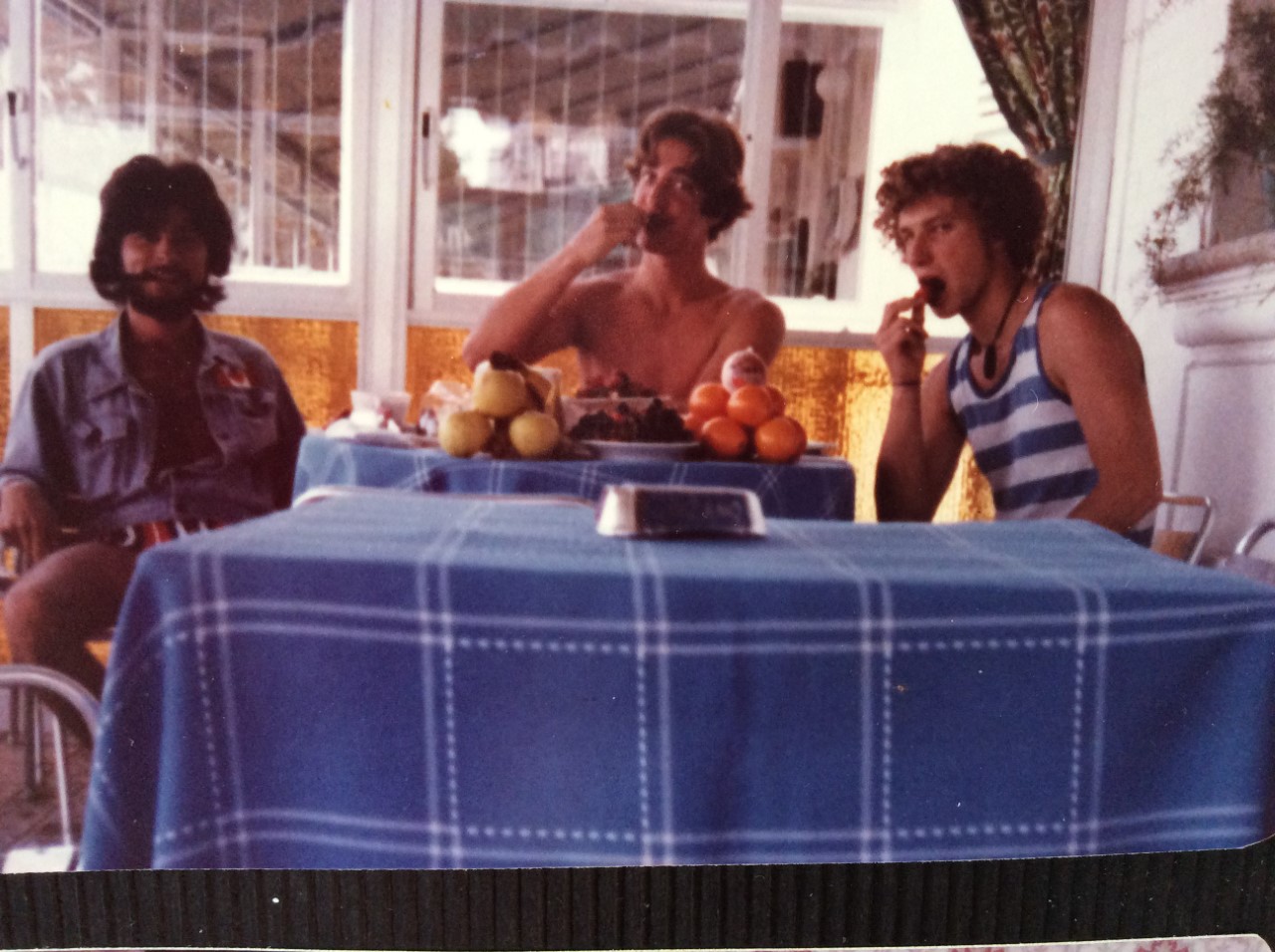
Now follows the pictorial essay of Europe on $10 a day.   


Monday, May 22, 2017

PRISON NOTEBOOK (A fiction by Dinshaw Patel)

https://www.amazon.com/dp/1541379519/ref=sr_1_1?s=books&ie=UTF8&qid=1495034283&sr=1-1&refinements=p_27%3ADinshaw+Patel

(Paperback can be purchased directly from AMAZON)

Sam is a compulsive writer. Convicted for killing an intruder in his home, he writes the ‘Prison Notebook’ from his cell in solitary confinement. This is the second time in his life that he is imprisoned. Over fifty years earlier, he was in a juvenile jail falsely accused of raping his sister. In-between the two terms, he lived a hermit’s existence in the forest. There he decrypted god to discover serenity in the world of existential nihilism. From earliest days solitude remained his desired companion. He equates societal living with slavery where essence supersedes existence and turns living “into a numb, perfunctory experience.” The ‘Prison Notebook’ is a compilation of anecdotes drawn from the protagonist’s life. A tale is woven by connecting the dots from his childhood through to the end of his life. Each chapter title is a countdown to his seventieth birthday. On the same day, he plans to kill himself. For Sam, death is a transformation into a state of oblivion that alone can offer “ultimate freedom.” The story is nameless and placeless symbolising Sam’s own unadulterated psyche. He never mentions any character by name. There are two separate individuals in the book that he refers to as the “boy.” His own name too is only revealed by the author of the epilogue. The location where it transpires is similarly unknown. Yet, given that there are references to Genet, Orwell, Shakespeare and the Bible, it can be deduced that the events take place in some country in the western hemisphere. The ‘Prison notebook’ is a novel questioning the foundation of cultural values imposed by society.

Sunday, February 21, 2016

Bicycling from London to Paris (2015)

Bromptoning from London to Paris
(Saturday 12th to Wednesday 16th September2015)

The route was between two iconic sights – from the London Eye to Cathedrale Notre Dame de Paris.
After five days, approximately four hundred kilometers and over two hundred thousand pedalling rotations, I completed the journey that had dominated me for the past several months.
En route there was a stream of breathtaking scenery, quaint towns and gastronomic delights.
Yet, upon completion, when asked, “What was the best part of the trip?” My facetious but truthful reply was, “when cycling downhill.”
-------------
Except for the inconvenience of pelleting rain on the last day or over exhausting myself cycling one hundred and twenty kilometers at a stretch in one day, it went without any disruptive mishaps or annoyances. Much credit goes to the Brompton bicycle for its reliability, manoeuverability and functionality. A piece of masterful engineering and design. It performed flawlessly. No punctures with the Schwalbe Marathon tires, smooth gear changes through its combination of Wide Range gear hub and a two speed derailleur system and a rattle free performance. Folded, it is two feet by two feet by one foot. The light weight (13 kilograms) Brompton fitted perfectly in a suitcase to carry it as normal luggage across the pond.


Sunday, September 2, 2012

A bit of tongue-in-cheek humour on the Evils of Religion

A bit of tongue-in-cheek humour on the Evils of Religion
By
Dinshaw Patel


  • They believe in a load of Bronze Age absurdities.
  • They have fetishes for pain and suffering. 
  • Their ethics are wishy-washy and often not based on any rational foundation.
  • Some mutilate their bodies in name of their imaginary god(s).
  • As Bertrand Russell aptly puts it, “My own view on religion is that of Lucretius. I regard it as a disease born of fear and as a source of untold misery to the human race.”
  • They kneel and make absurd gestures in unnatural postures facing the sun, symbols, mountains, sea, fire, photos, statues, stone structure, rocks and all that challenges rationality.
  • The Zoroastrians not only wash themselves with bull’s urine but also drink it polluting their own bodies inside out.
  • They refer to their god as omnipotent.  It would be more apt to call him impotent. 
  • In their metaphysics, they build absurd complex structures on marshmallow foundations.
  • Their institutions are amongst the richest and yet they are exempted from paying taxes.
  • Their prayers are loud and irritating.  The Zoroastrian priests whine and wail as if traumatized by bellyache, while the Mullahs howl and scream with deafening sounds.  Others moan as if suffering from constipation.   
  • They are like infantile who cannot do without an illusionary daddy-crutch in the sky.
  • They destroy spontaneity from an early age by implanting their morbid myths.
  • They divide humanity and are often the cause of wars.
  • They rule by the fear of the wrath of an delusional entity.
  • They have imaginary friends among the dead, winged humans and all that remains unseen.
  • Their god has as much a reality-status as Santa Claus.  
  • They prefer imbecilic fables  to intelligent literature.
  • They prefer preaching to listening.
  • They prefer faith to reason.
  • And, they prefer death to life. 


-------

THE FINGER


The Finger by Dinshaw Patel  - (2016)

“The Finger” is 30 X 30 (inches) canvas with a collage of pages taken from religious books of Judeo-Christian, Zoroastrian, Mohammedan and other delusional faiths.  The middle finger (with Rodin's Thinker) symbolizes a defiant gesture against all the hocus-pocus gibberish that is spewed by the religionists.  

___________

    A video from the Zoroastrian (fire) temple, Udvada Atash Behram, India.

A Zoroastrian priest whining and wailing as if traumatized by a bellyache while giving reverence to a fire that has no utility (except delusional).